
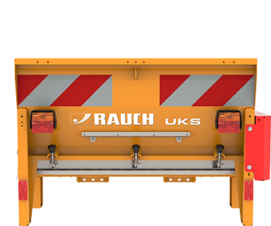
Box spreaders for winter maintenance: precision technology for every application
RAUCH box spreaders and winter service spreaders are the ideal solution for precise winter maintenance on pavements, in parks and on small to medium-sized areas. Depending on the application, the requirements regarding spreading rate, equipment and ease of use vary significantly.
On this page, you will find an overview of the main areas of application, the technical differences, and a direct selection guide for suitable models such as the UKS 100 and UKS 120.
Which box spreader is right for your needs?
Choosing the right box spreader depends primarily on the location, the size of the area and the features you require. This brief guide will help you find the right category more quickly.
For pavements and confined spaces
A compact solution for precise spreading on smaller areas and in confined spaces.
For car parks and medium-sized areas
Greater capacity and range for regular use in municipal or commercial winter maintenance.
For users with documentation or convenience requirements
Suitable when features such as speed-dependent metering or documentation are important.
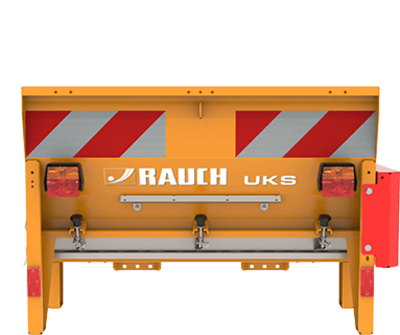
RAUCH Box Spreaders Compared
Once you have decided on the intended use, it is easier to choose the right model. The following overview shows the key differences at a glance.
| Model |Suitable for|Tank capacity|Working width / Application|Features / Special characteristics| | |
| UKS 100 | |Pavements, confined spaces|200–280 l|precise, manoeuvrable|dosing slide, mixing system |
| UKS 120 |larger or more frequent applications|240–340 l|more compact|greater capacity, same standard equipment |
What are the advantages of a hopper spreader for winter maintenance?
Box spreaders excel in winter maintenance thanks to their precise technology and reliable application of a wide variety of gritting materials. Depending on the specification, they offer additional functions that make operation significantly more efficient.
Precise dosage
Precise adjustment of the spreading rate is crucial for economical and environmentally friendly operation. A calibrated metering system allows for exact control of the spread.
Reliable material flow
A consistent material flow is crucial, particularly with damp or poorly flowing spreading materials. Special agitation systems ensure that the spreading material is continuously fed to the discharge point.
Clean and controlled distribution
Uniform spreading ensures safe traffic areas and prevents over-application. Controlled application is particularly crucial on pavements and sensitive surfaces.
Automation and documentation
Modern control systems enable speed-dependent metering and the documentation of the spreading process. This increases efficiency and ensures greater transparency during operation.
Find out everything about the Quantron.
Choose a box spreader and compare models
Which box spreader is suitable for pavements?
Compact box spreaders with precise metering are ideal for pavements and narrow areas. The key is even distribution with small quantities of grit.
How do the models differ?
The differences lie primarily in hopper size, performance and features. Larger models are designed for higher coverage rates.
Which box spreader is right for my needs?
The choice depends on the area, frequency of use and requirements.
Box spreaders in winter maintenance: use and gritting materials
How much salt is required per square metre for winter maintenance?
The amount of grit used depends on the weather and the area being treated. Precise dosing saves material and reduces environmental impact.
Which is better: salt or grit?
Salt de-ices, grit improves traction. The choice depends on the application and local regulations.
How can blockages be prevented during gritting?
A consistent flow of material is crucial. Suitable gritting material and the right technique minimise disruptions.