XactMap and XCheck make precision fertilisation simple and cost-effective
Satellite data reveals variations in the field; artificial intelligence optimises the spreader settings
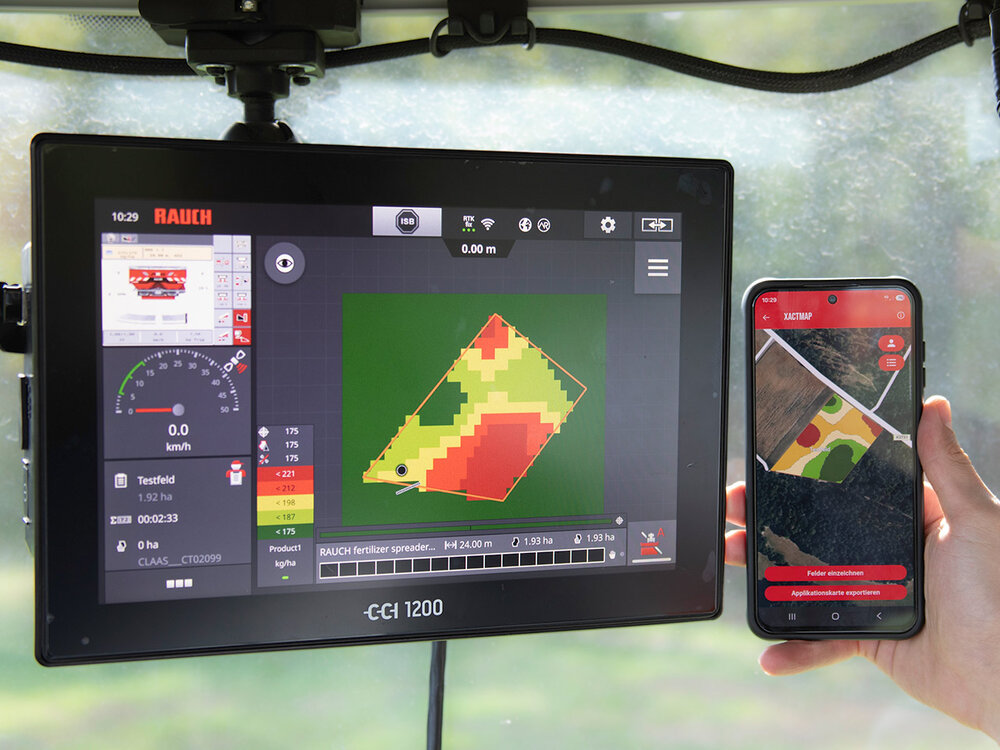
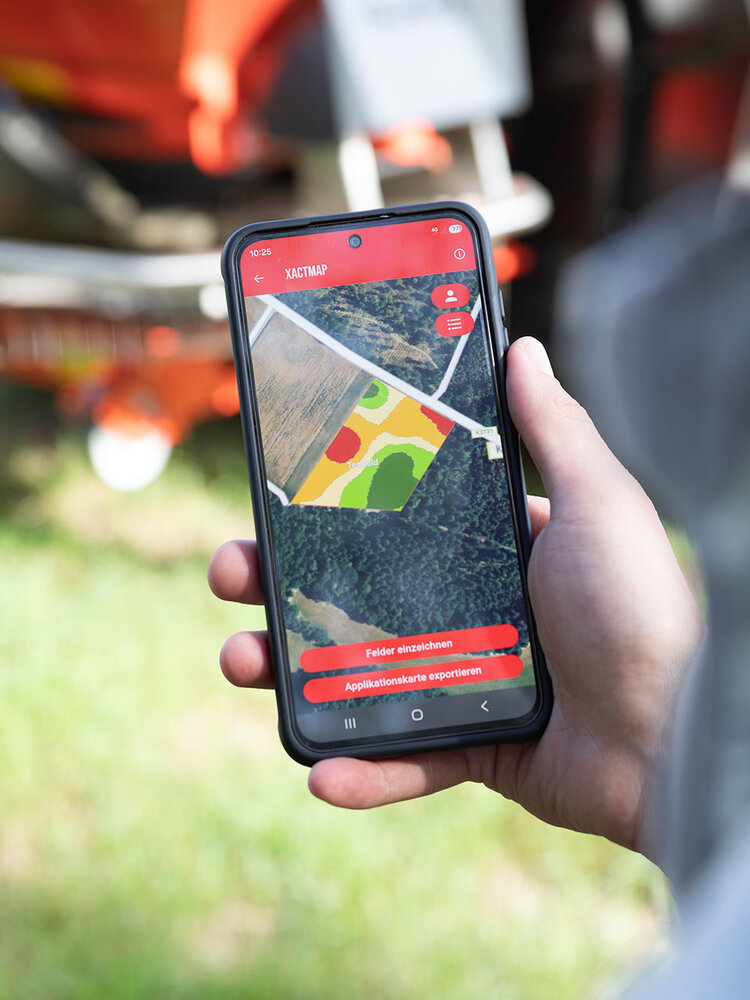
Rheinmünster, October 2026 – With XactMap and XCheck, RAUCH Landmaschinenfabrik GmbH is expanding its RAUCH app to include two practical tools for precise and resource-efficient fertilisation. In collaboration with Smart Farming specialist FarmBlick, RAUCH is making it particularly easy to get started with site-specific fertilisation. Farmers can manually map individual fields directly within the app and, using satellite-based biomass data, see at a glance how evenly their crops are developing. No registration or user account is required for this initial step.
The biomass visualisation clearly highlights differences within a field and provides an initial basis for assessing field heterogeneity. Anyone wishing to subsequently create application maps and transfer them to their machinery can sign up for the advanced version.
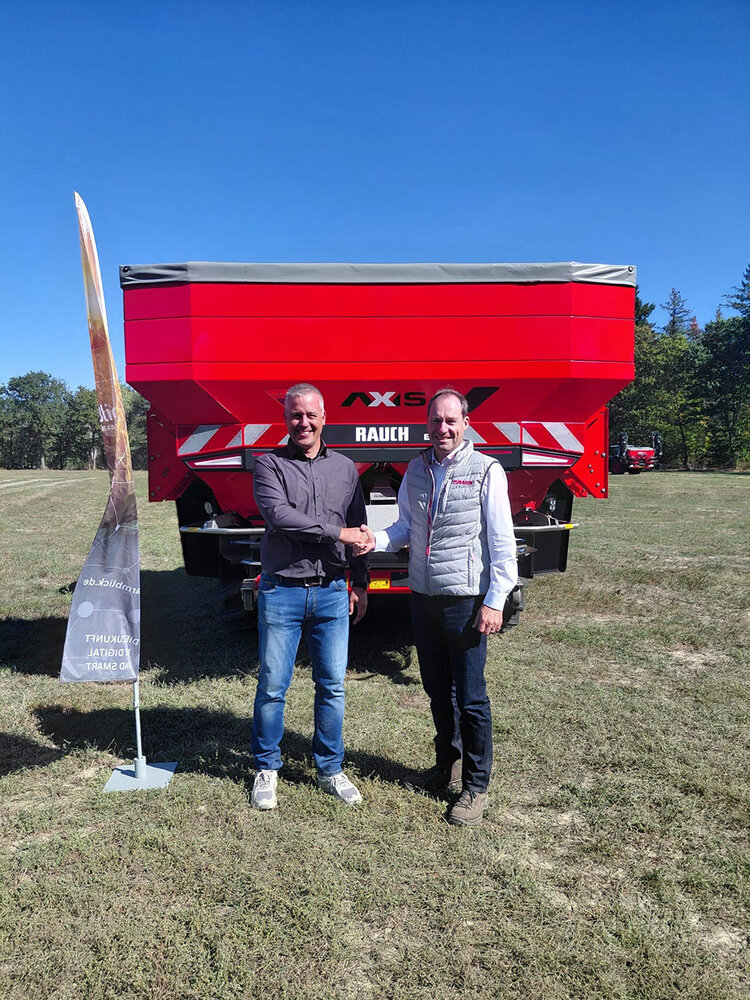
“With XactMap, we make getting started with precision fertilisation as easy as possible. Any farmer can get an overview of their land without registering. Those who wish to go a step further can apply the insights directly to targeted fertilisation,” explains Wilfried Müller, Managing Director of RAUCH Landmaschinenfabrik GmbH.
From individual fields to a fertilisation strategy for the entire farm
The browser-based software allows all of a farm’s fields to be conveniently mapped, managed and viewed together. Based on the available satellite and biomass data, the farmer defines their fertilisation strategy for the entire farm. They can choose between two approaches. With the homogenisation strategy, less developed sub-plots within a crop are specifically supported in order to even out differences within the crop as much as possible. The yield potential strategy, on the other hand, bases the fertiliser application rate on the varying productivity of the sub-plots and provides correspondingly greater support to areas with higher yield potential. The farmer decides for themselves which strategy is best suited to their land and farm objectives.
To implement this, sub-plot-specific application maps are created. These can be transferred wirelessly via agrirouter or, alternatively, via a USB stick to a suitable terminal with an activated Task Controller. This way, the planned fertiliser strategy is sent directly to the machine.
“The key is that comprehensible data is turned into a concrete decision for work in the field. XactMap combines simple field analysis with a seamless process right through to the application map,” says Oliver Martin, Managing Director of FarmBlick.
Targeted fertiliser application and resource conservation
Through site-specific application, fertiliser is applied more precisely where the chosen strategy and crop stand require it. This can prevent over-fertilisation, significantly reduce fertiliser use and minimise unwanted nutrient runoff into the environment. The actual extent of the savings depends on the fields, the crop stand and the fertiliser strategy.
XactMap was trialled in practice in spring 2026 in collaboration with test customers from RAUCH and FarmBlick. Whilst individual fields can be viewed without registration, the paid version offers advanced planning and the use of application maps. The annual licence currently starts at 314 euros plus VAT. Given the potential value of the fertiliser saved, this fee can represent an economically attractive investment.
XCheck checks lateral distribution with just one photo
With XCheck, RAUCH supplements digital fertiliser planning by monitoring the actual spreading quality in the field. Specially developed, space-saving, foldable collection trays record the lateral distribution of the fertiliser during a test run. All that is then required is a single photograph of the measuring hopper. The AI-supported image analysis in the RAUCH app uses this to determine the appropriate settings for the discharge point and disc speed. The recommendation can be transmitted online via Wi-Fi to the fertiliser spreader. According to RAUCH, this reduces the testing process from over 15 minutes to less than seven.
XactMap and XCheck thus complement each other directly in practice. Whilst XactMap prepares the required fertiliser quantity for the individual sub-plots, XCheck helps to apply the fertiliser with the most uniform lateral distribution possible. Both applications help farmers to combine precision, cost-effectiveness and environmental protection.